
Edited on September 3, 2016 to add photos. Scroll down to just past the supply list section to see them.
I have been fascinated with Pebeo’s “Fantasy” Paints; Moon, Prisme, and Vitrail for a long time. The way they behave, and the fabulously patterned results they create, drew me in right from the beginning.
I’ve been fortunate to see them demoed at various trade shows and watched my fair share of YouTube videos, consistently captivated by the movement and interaction between three of them. Watching them self-manipulate into patterns, some reasonably predictable and some not so much, is like watching a magic show in slow motion. Watch, walk away for 20 minutes, and when you come back you’re very likely to see more change. Of course that stops as the paint begins to dry, but for the first couple of hours… magic!
A while ago I was given some paint and one of the Liquid Art Panels. Rubbing my hands together in glee, I felt like a 16th century alchemist just waiting to create magic. Thinking I knew what I was doing, I jumped in with both feet (right into the deep end) and added paint to the Liquid Art Panel; some of this, a bunch of that, a little of something else. I quickly discovered that running before I walked was not a good choice – did I mention the epic fail?? Let’s just say the results on that first piece were… not what I was hoping for.
I took a big step back, spending a lot of time figuring out what the reactive characteristics of the paints were. How do Moon and Prisime self-manipulate? What happens when they’re combined with each other? Or with Vitrail? Glitter Medium? I NEED Glitter Medium. What happens when you add it to a piece?
Reactive is the key word and in today’s video you’ll see me demo how to create what I call reaction chips. Unlike color chips that are meant to provide a sample of what a color looks like, my reaction chips capture the magic of how the paints interact. If you’re new to them I highly recommend that you take the time to make some. Let them dry, then adhere to the pages of a small journal so you’ll have them as a reference. I think you’ll find them invaluable.
I have a freebie promotion for you too. Starting today, August 31 through Friday September 2, 2016 we’re giving away small pieces of chipboard and acrylic shapes so you can experiment with the paints on some fun surfaces.
Spend $35 and I’ll give you a set of three of the Mini Acrylic Hearts. Spend $50 and I’ll give you those hearts plus 3 chipboard squares measuring 3″ x 3″. This way you have small pieces to work on as you learn about the paints. You do not need to do anything. The warehouse will send your freebies.
I hope you have as much fun making magic as I have!
Supplies For This Video
Pebeo Auxiliaries (Lightening & Glitter Mediums)
140# Watercolor Paper (for your reaction chips)
Joggles 6″ x 6″ Acrylic Book Covers
Joggles Acrylic Mini Hearts Set of 3 Styles (6 pieces in total)
Joggles Precut Chipboard (ATCs, Squares, Books, Book Covers, etc)

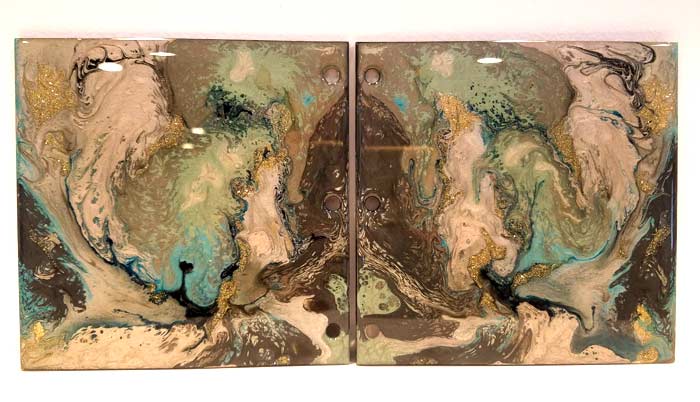
When I make the book covers using the clear acrylic pieces I always try to have them match, at least along the edge where the binding holes are. I feel this makes them appear to be a unified set rather than two disparate pieces thrown together. There is a link to the blank Acrylic Book Covers just above these photos, in the supplies section, if you want to give them a try.








9 Comments
WOW. says it all. OK, maybe Amazeballs as well. Stunning would be applicable too. I’ve seen Prisme and Moon together on jewellery pieces but never on acetate before. Think I’ll have to go and lie down for a bit to recover 🙂
Thanks very much! The paint is so much fun to work with. :+)
OMG! Love this stuff!
Me too! It’s my obsession.
What colors did you use for the two covers, supply list please thanks
I worked on those covers weeks ago and don’t recall the colors, I’m sorry.
Barb, quick question. Does the $35 have to be towards Pebeo products to get the chipboard and hearts? Thanks.
Nope, it can be any products!
Thank you so much. I got some for Chistmas and now I have a clue!